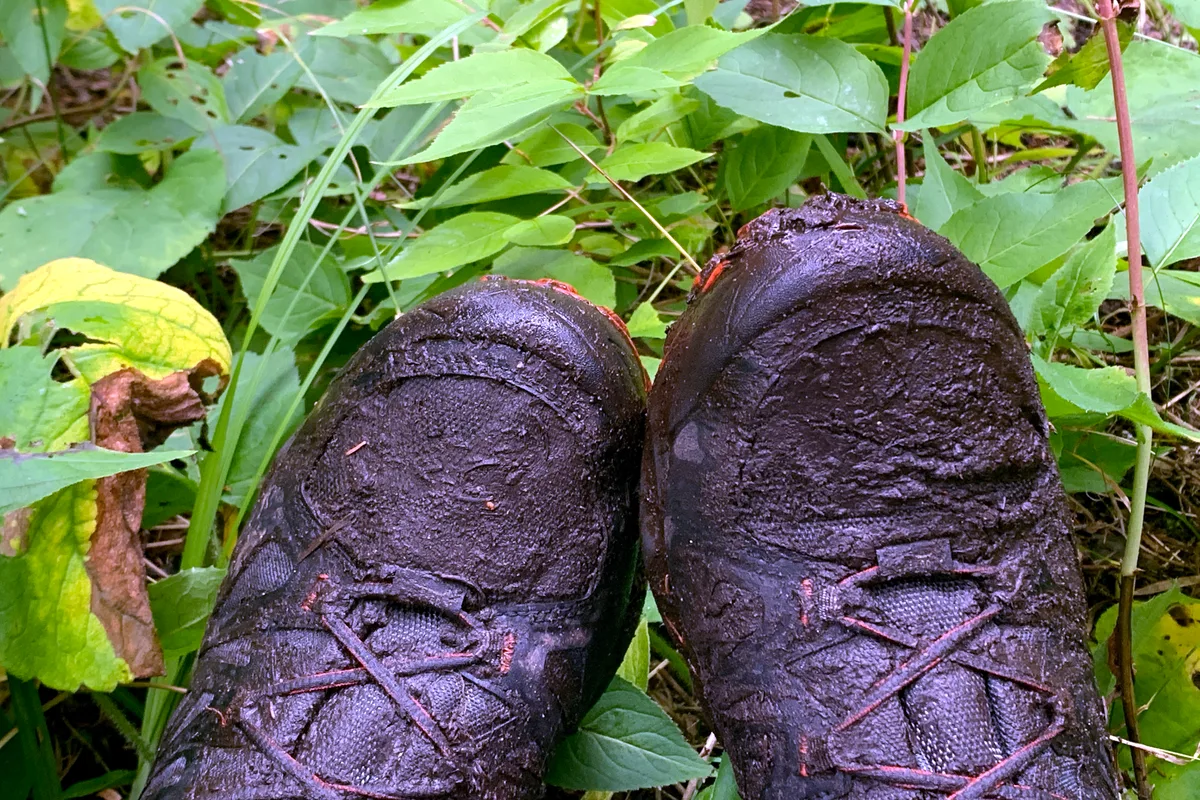
Work Boots That Could Stand Up by Themselves
A work boot holds twelve hours of sweat a day, six days a week, inside a waterproof membrane that keeps the weather out and the moisture in. The fix is drying the boots properly, then eliminating the odor, in that order.
The short answer
Dry them like equipment, then eliminate: FunkAway into the boots after the shift, and the boots onto air (or a low-heat boot dryer) until the next one. A boot worn twelve hours a day without drying will keep building odor no matter what you spray in it. The spray is step two; the drying is the main job, because waterproof membranes make work boots the slowest-drying footwear in the house.
Why does this happen?
Work boots concentrate every shoe-odor variable and add two of their own. The wearer's feet work (and sweat) harder than office feet. The boot's construction, designed to keep water out, keeps sweat in: waterproof membranes and insulated linings slow evaporation to a crawl, so a boot that takes in a day of sweat may need two days of rest to release it, while the roster gives it twelve hours. The result is a lining whose bacterial load compounds across the week, and an odor with the structural depth office shoes never achieve.
The response matches the structure. Drying becomes infrastructure rather than advice: loosened laces, insoles pulled, boots inverted or on a dryer that moves warm air through them at temperatures linings tolerate. The eliminator spray then treats a boot that is no longer making odor faster than the spray can remove it. It is the same order of operations as this family's car page: dry first, then treat. Rotation across two pairs is the gold standard and also a real capital decision, so this page is honest that one pair plus disciplined drying is the working compromise most boots actually live under.
The fix, in order
In order, cheapest first. Stop at the step that solves it. The product step is the last resort, not the starting point.
Free step
Strip and air them the moment the shift ends
Laces loose, insoles out and standing separately, boots open in moving air, never in a closed locker or gym bag overnight. The first hour of drying does the most good. Closing a warm, wet boot in a locker or bag is how the smell builds up.
Free step
Accelerate with newspaper or a boot dryer
Newspaper stuffed in absorbs a shift's moisture overnight (change it if soaked); a low-heat boot dryer does the same job on a timer with no newsprint budget. Heat discipline matters: radiators and high heat crack leather and kill adhesives, so warm air, never hot surfaces.
The product step
Spray FunkAway into the dried boot
Once the inside feels dry to the hand, spray FunkAway through the boot's interior and on both sides of the insoles. The spray works on a dry boot. On a wet boot it cannot keep up, because the boot keeps making more odor. This is the same point the car and shoe pages make, and boots are where it matters most.
The product for this step
FunkAway odor eliminator (boot application), with drying discipline
Habit step
Rotate if the work allows, maintain the leather regardless
Two pairs alternating days is the structural solution and the page's honest recommendation for anyone whose boots are income equipment; where one pair it is, the drying steps carry the load. Leather care (cleaning, conditioning) keeps the exterior from cracking its way into leaks that restart the whole system.
The evidence, in tiers
Tier 1 · The method
The membrane-moisture model of work boot odor and the warm-air drying discipline are standard workwear and footwear guidance; the eliminator's chemistry class is the manufacturer's documented one.
Tier 2 · This product
FunkAway's record as this family's repeated pick is stated once here for all three of its pages: the discipline predicts outcomes, the product finishes them, and no single star figure from one format is allowed to stand for the system.
We have not worked a shift for this guide. The order of operations is verifiable by any boot owner across one week, which is the test protocol the ladder amounts to.
Tier 3 · What owners report
Working owners report that the insoles-out habit and the dryer are what changed things, and that the smell became a weekly maintenance job instead of a constant problem. The failures involve lockers (sealed, warm, and dark, which is ideal for bacteria) and skipped drying in the busy season. The steps above name both in advance.
The alternatives, conceded where they win
| Option | What it is | The honest verdict |
|---|---|---|
| Drying discipline plus FunkAway | Infrastructure first, molecular elimination second | The pick: it is the only row that respects the membrane problem, which is the difference between a work boot and every other shoe in the house. |
| Odor sprays alone, nightly | Chemistry without drying | It loses on simple arithmetic: a wet boot makes odor compounds faster than a spray can remove them, and nightly spraying of a wet boot is the most documented disappointment in this family. The bottle is not the problem; the wet boot it is sprayed into is. |
| Replacement boots each season | Retiring the problem at retail | Wins when linings are spent or membranes failed (the triage), and some trades expense boots annually anyway; it loses as an odor strategy for sound boots, because the new pair inherits the same locker, roster, and membrane within a month. |
The honest price comparison
The honest comparison is a boot dryer at $25 to $45 once, against boots at $120 to $250 retired early over their own atmosphere, plus the spray at under $10 serving the whole family's smelly footwear. Work equipment deserves maintenance economics, and boots are equipment.
Where it falls short
Below are the weaknesses from the product's own record: where buyers say it falls short, in their numbers.
- One pair on a six-day roster may never fully dry even with discipline; the compromise is stated rather than solved, and rotation remains the true fix where budgets allow.
- Elimination does not repair cracked leather, failed membranes, or a lining colonized to its depth; the triage's exits are real doors, not rhetoric.
- Boot dryers draw power and counter space permanently; the newspaper method is nearly as good for the disciplined, and this page rates them as equals with different currencies.
The product, in short
FunkAway odor eliminator (boot application), with drying discipline
Questions people ask next
How long should boots rest between shifts?
Ideally a full day per day worked, which is the rotation argument in one line. On a single pair with twelve hours between shifts, the accelerated drying steps exist to compress two days of evaporation into the night; insoles out is the highest-yield minute of them.
Can I wash the insoles?
Yes, most foam insoles tolerate hand washing with mild soap and a full air dry, and a washed, dried insole resets much of the boot's odor in one act. A spare insole pair, rotated, is the budget version of the two-boot rotation and nearly as effective.
Does freezing the boots kill the smell?
It pauses the bacteria, which start again when the boot thaws. Hygiene testing of the freezer idea has shown it does not work. Cold pauses the smell; it does not stop it.
What about cedar inserts and charcoal bags inside?
They are legitimate helpers in a boot that has already been dried: they absorb the day's leftover moisture and add scent. They cannot rescue a wet boot full of bacteria. The order matters, always: dry first, then maintain.
Workwear footwear guidance on drying and membrane care · FunkAway product documentation (November 2026)
The Fix JournalCase 09Car & Fabric