Coffee at Home Tastes Bitter: The Grinder Is the Usual Suspect
Most bitter home coffee is an extraction problem, and the biggest single factor is grind consistency: a cheap blade grinder produces dust and large chunks in the same scoop, and the dust over-extracts into bitterness that no technique can fix.
The short answer
Fix the grind and the bitterness usually goes with it: the Baratza Encore's burrs produce the even particle size that even extraction requires, and it is the specialty coffee world's standard first grinder for that reason. Blade grinders chop beans into dust plus chunks: the dust over-extracts and tastes bitter while the chunks under-extract and taste sour, and no water temperature or ratio can fix both at once. Work through the diagnostic steps below first; if your grinder is a blade, you have found the limit of your coffee.
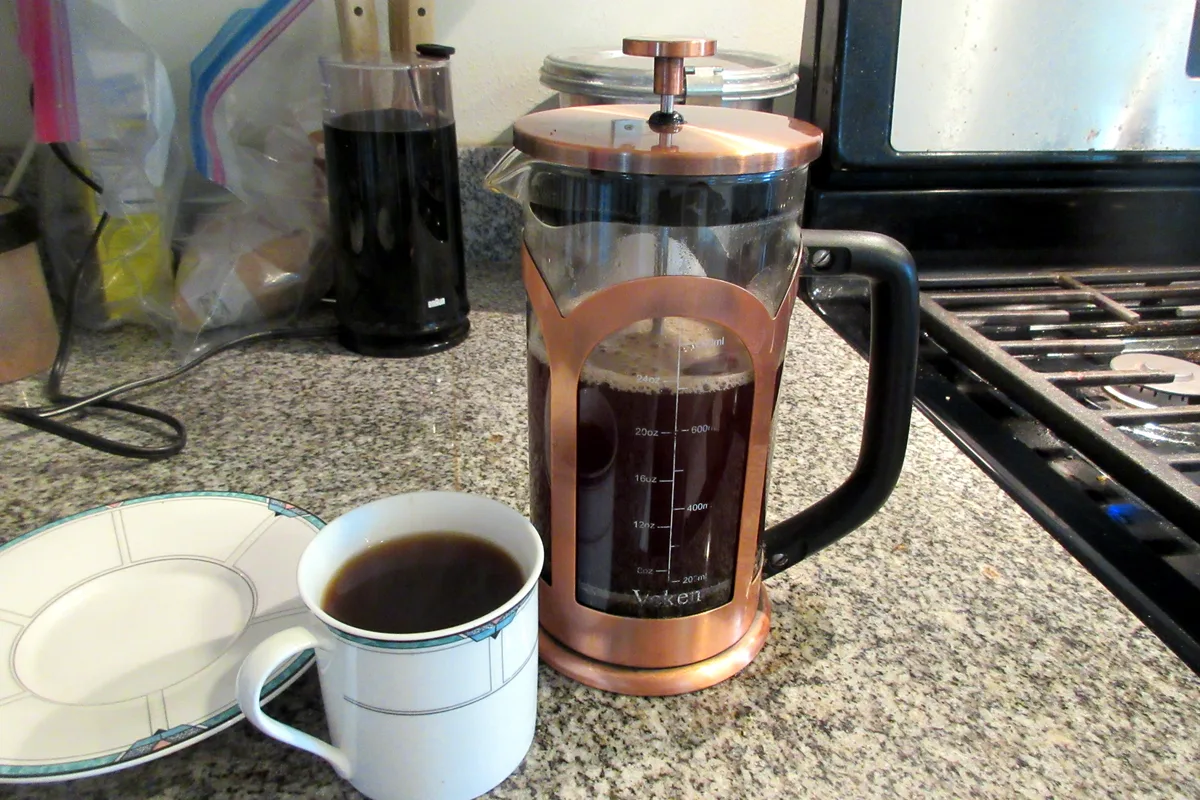
Why does this happen?
Extraction is about surface area: hot water dissolves coffee's compounds in a rough order, acids and bright notes early, sugars in the middle, and the bitter, harsh compounds late. For extraction to be even, the water has to reach the center of every particle at about the same rate, which requires similar particle sizes. A blade grinder's output spans a huge range of sizes, so a single brew is over-extracted and under-extracted at the same time, and the cup tastes bitter and sour at once, which drinkers blame on the beans, the water, or themselves. Burrs crush beans between two machined surfaces at a set gap, and produce a spread of sizes tight enough that adjusting (finer or coarser, hotter or cooler, longer or shorter) becomes predictable instead of a gamble.
Bitterness has other causes too, and an honest page lists them before selling you a machine: water too hot for the method, contact time too long (the forgotten French press), a ratio heavy on coffee, stale or very dark-roasted beans (whose bitterness is the roast, not the extraction), and, from this site's own Home Surfaces pages, a scaled machine brewing cool and slow or a dirty machine brewing through rancid residue. The diagnostic steps below spend nothing first, because the grinder is the answer only when the free suspects are cleared, and it is the answer surprisingly often.
The fix, in order
Each step costs more than the one before it, so stop at the first one that solves the problem; the product is there only if the free steps run out.
Free step
Clear the free suspects first
Descale the machine (see the citric acid page in Home Surfaces), brew with water just off the boil for manual methods (or check the temperature), time how long the water stays on the coffee, and weigh a brew or two (a 1:15 to 1:17 coffee-to-water ratio is the standard place to start). Change one thing per brew and keep notes.
Free step
Interrogate the grinder honestly
Spread a scoop of your grounds on white paper. Blade-ground coffee shows visible dust and shards side by side; burr-ground coffee looks like uniform grit. If yours looks like confetti, the diagnosis is already made, and no other change will save the cup.
The product step
Grind with the Encore, dialed to your method
Baratza Encore at the maker's suggested starting setting for your brewer, then adjust one notch at a time across days: finer pulls more extraction (toward bitter if overdone), coarser less. The grinder's real virtue is repeatability: you can return to the same setting, which makes your notes actually useful.
The product for this step
Baratza Encore conical burr grinder
Habit step
Buy beans like freshness matters, because it does
Buy whole beans roasted within the month, store them airtight away from heat, and grind per brew. The Encore makes fresh grinding take ten seconds, which is what makes the whole freshness approach practical.
The evidence, in tiers
Tier 1 · The method
Extraction order and particle-size distribution effects are coffee science documented across the Specialty Coffee Association's research and brewing standards; burr-versus-blade distribution is measurable and uncontested.
Tier 2 · This product
The Baratza Encore's standing comes from its place in the category: it is the standard recommendation of specialty coffee shops and teachers for a first burr grinder, from a manufacturer known for stocking parts and supporting repairs (a service culture that lasts a decade or more, which is unusual in appliances). This page quotes no star rating, because how the grinder works and the agreement behind it in the category are the right evidence for equipment advice.
We have not run a tasting panel for this guide. The free diagnostic steps let any reader judge their own grinder on white paper in one minute.
Tier 3 · What owners report
Owners report the big change the physics predicts (the same beans becoming a different, sweeter cup). The complaints concentrate on static mess and noise, the Encore's known costs, which are real but easy to live with at its price.
The alternatives, conceded where they win
| Option | What it is | The honest verdict |
|---|---|---|
| Baratza Encore burr grinder | Uniform grinding, 40 settings, repairable build | Our pick: it removes the one problem that makes every other adjustment meaningless, from the maker whose parts and support treat a grinder as equipment that should last a decade. |
| A premium hand grinder | Manual burr grinding, excellent distribution, no motor | Wins for one or two cups a day, for travel, and for silence at 6 a.m. It loses for households and busy mornings, where grinding for four people by hand is a ritual most people give up within a few months. The quality is equal; the labor is not. |
| A blade grinder used with tricks (shaking, pulsing, sifting) | Mitigating a bad distribution | Wins only because you already own it, for a few weeks of stubbornness. Every trick narrows the spread of particle sizes without closing it, and sifting throws away a third of the coffee to achieve a worse version of what a burr grinder produces as standard. The limit is in the shape of the grind itself. |
The honest price comparison
Compare it with the coffee itself: a household drinking two cups a day spends $400 and up a year on beans, and a blade grinder spoils part of every one of those cups. The Encore at $150 to $170 works out to pennies per cup across a life of a decade or more, and it is the rare upgrade you can taste the same morning.
Where it falls short
The weaknesses below come from the product's own review record. Hiding them would make this an advertisement, so they are here.
- It is loud, and it throws static-charged grounds like every grinder in its class. The noise costs a household its morning peace, and that is a real cost.
- It will not rescue stale beans, a dirty machine, or a roast you simply dislike. The diagnostic steps come first because spending grinder money in those cases only buys an expensive confirmation of the real problem.
- Espresso is beyond what it is made for: the Encore serves filter methods superbly and espresso only marginally (the maker's own positioning), and espresso households move up to the Encore's bigger, more expensive siblings.
The product, in short
Baratza Encore conical burr grinder
Questions people ask next
How do I know if it is the beans, not the grinder?
Taste the same beans at a good café or at a friend's house with a burr grinder: if they taste good there and bitter at home, your process is the difference. If they are bitter everywhere, change roasts (lighter, fresher) before changing equipment; some bitterness is part of a bean's character, not a defect.
What setting should I start at?
The maker publishes starting points per method (drip machines mid-range, French press coarse, pour-over medium-fine). Start there, brew, taste, and move one notch at a time. Your own taste at your kitchen table is the real guide; the numbers are just a way to record what worked.
Does water really matter that much?
At the margins, yes: heavily chlorinated tap water flattens coffee, and very hard water scales machines (see the descaling page). Filtered water is the standard recommendation, but it matters far less than grind, which is why the steps are in this order.
How long will it last?
Baratza is quietly known for parts availability and repair: burrs are replaceable wear items, motors and gears are stocked, and decade-old Encores still in service are common. In an appliance category where most products end up in landfill, that is worth naming.
Specialty Coffee Association brewing science on extraction and grind distribution · Baratza product documentation (November 2026)
The Fix JournalCase 07Family & Friction