Mice in the House: Droppings in the Pantry
One mouse in the pantry means a population with a route in. They enter through gaps a pencil's width, and traps without sealing only catch mice while more come in. Seal the building first, then trap the mice already inside.
The short answer
Seal first, trap second: find and close the pencil-width gaps they use, then set Tomcat Press 'N Set traps along the walls where droppings appear. The traps hold 4.1 stars from 769 ratings at Walmart (November 2026). A single trap is a gesture. A sealed building with a line of traps is a solution.
Why does this happen?
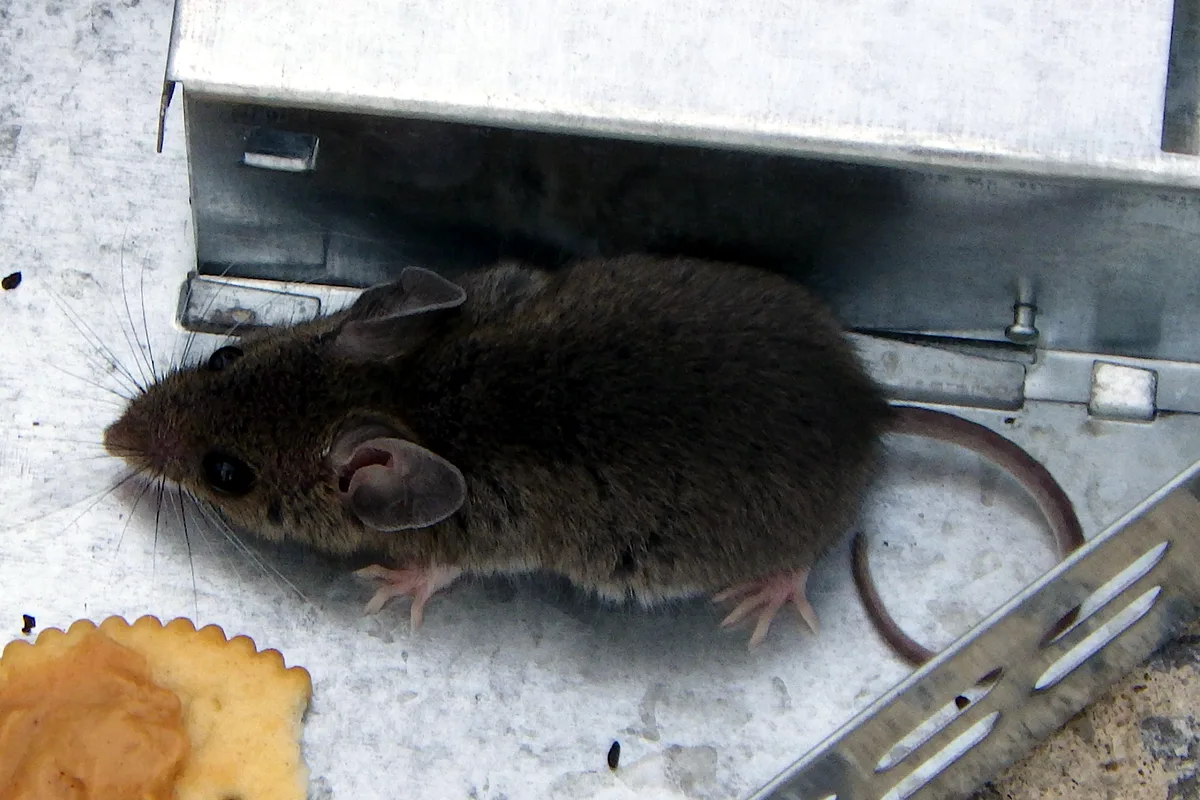
House mice live commensally: they nest within a short run of food, travel along walls (their whiskers and bodies hug edges), and can pass any gap their skull fits, roughly a quarter inch. Droppings in the pantry mean a harborage nearby, often in the wall void or under the sink cabinet, and a night route to food. Populations turn over fast (a female raises several litters a year). That is why killing mice without closing the entry points leaves you with mice for good: the habitat stays advertised and the neighborhood refills it.
Control therefore runs in a fixed order. Exclusion shrinks the problem to the current residents: copper mesh or backer rod and sealant in gaps (mice chew foam alone), door sweeps, and screens on vents. Trapping then removes residents, with traps placed on the travel lines (perpendicular to walls, trigger toward the wall) in numbers matching the sign: for an established presence, a dozen traps is a starting line, not an excess. Poison is deliberately not this page's method: it kills mice inside walls (odor), endangers the pets and wildlife that eat poisoned mice, and treats entry as permanent.
The fix, in order
Cheapest first, in order. When a step solves it, you are done; the product step is for the cases the free steps cannot finish.
Free step
Read the sign and map the routes
Droppings concentrate along travel lines and near food. Note where they are densest, check under the sink, behind the stove, and along the basement rim. You are drawing the map the traps and sealant will follow.
Free step
Seal the entries you find
Copper mesh packed into gaps around pipes and wires, sealant over it, sweeps under doors with gaps, and screens checked. Work the utility penetrations first; they are the highways. This step is dull work, and it is the foundation of the whole fix.
The product step
Set a real trap line with the Press 'N Set traps
Bait with a pea-sized smear of peanut butter, traps perpendicular to walls along the mapped routes, several per zone, checked daily. The enclosed design lets you set and dispose without contact, which is why this class replaced the classic trap for most households.
The product for this step
Tomcat Press 'N Set mouse traps
Habit step
Remove the welcome: food and harborage discipline
Dry goods into hard containers, pet food not left out overnight, and clutter against foundation walls reduced. Mice commute between food and shelter; shorten the commute's value.
The evidence, in tiers
Tier 1 · The method
Exclusion-first rodent control is the public-health and extension standard for commensal mice; the quarter-inch gap rule and wall-line trap placement are documented in that guidance.
Tier 2 · This product
Tomcat Press 'N Set traps hold 4.1 stars from 769 ratings at Walmart (November 2026). The rating is in the middle of the pack, and we quote it as it is. The pick rests on the enclosed design, which is easier to handle, and on the placement method, which matters more than the trap's brand.
We have not trapped mice for this guide. The method is extension-standard; the product is the household-grade instrument for it.
Tier 3 · What owners report
Owner complaints concentrate on traps set singly in open floor (wrong place, wrong number) and on bait stolen by very small mice without triggering, which a firmer bait smear and a wall-line set address. Success reports read as: sealed, trapped for a week, silent.
The alternatives, conceded where they win
| Option | What it is | The honest verdict |
|---|---|---|
| Press 'N Set traps plus sealing | Enclosed snap trapping on travel lines after exclusion | The pick for the standard case: humane-speed kill, no poison in the food chain, no contact handling, and a building left closed behind it. |
| Poison bait stations | Anticoagulant or acute toxicants | Wins on labor for large rural populations, and professionals do use it in tamper-proof stations; it loses in homes on secondary poisoning (owls, hawks, cats), in-wall deaths, and because it accepts infinite entry. Not this page's method, by name. |
| Live-catch traps | Capture for release | Wins on conscience for a single mouse; it loses as population control (release must be far away to matter, and re-entry is instant into an unsealed house), and released commensal mice mostly die or become a neighbor's problem. |
The honest price comparison
The honest comparison is a pest company's rodent program at $200 to $400 for the initial visit and contract pressure after. For a standard mouse presence, the sealant, mesh, and traps together run under $30 and the skills are caulk-gun level.
Where it falls short
What follows is drawn from the product's own reviews: the complaints and failures buyers report after living with it.
- It is a week or two of daily trap checks, not a single evening; households wanting a one-act fix will be tempted by poison and should reread that row.
- The traps' 4.1-star record includes real misses on juvenile mice; numbers and placement compensate, brand loyalty does not.
- Exclusion is detective work on your knees with a flashlight. There is no version of this solution that skips it and still ends.
The product, in short
Tomcat Press 'N Set mouse traps
Questions people ask next
How many mice do the droppings mean?
More than one, almost always: a pantry route used nightly is a household, not a hermit. Plan for a population (a dozen traps, a week of checks) and be pleasantly surprised, not the reverse.
Where exactly do traps go?
Against walls, behind appliances, under the sink cabinet, perpendicular with the trigger end to the wall, exactly where droppings concentrate. Mice travel edges; a trap in open floor is decoration.
Is peanut butter really the best bait?
For house mice, yes. Peanut butter smells strong and is sticky enough that a mouse has to work at it, which triggers the trap, and it is cheap. Use a pea-sized amount. More just feeds the mouse without triggering the trap.
We caught six and the droppings stopped. Done?
Nearly: keep two set traps in the hot zones for another two weeks as sentries, and finish any sealing you postponed. Silence plus closed entries is the definition of done here.
Public-health and extension guidance on exclusion-first rodent control · Walmart product record for Tomcat Press 'N Set (November 2026)
The Fix JournalCase 09Home Systems